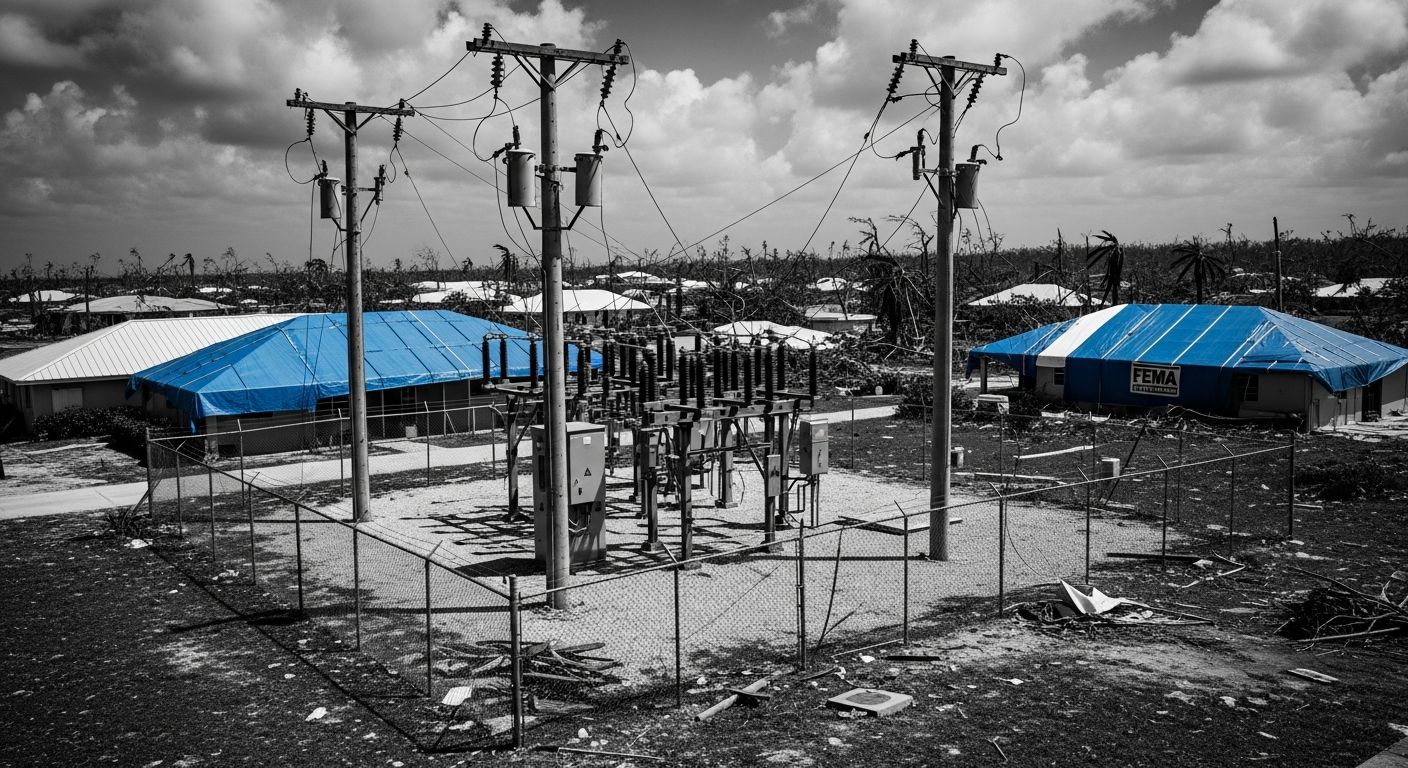
Nearly $11 billion in FEMA funds has been allocated for the reconstruction of Puerto Rico's electrical grid since Hurricane María. As of early 2026, the vast majority of that money has not been deployed in any way that has produced measurable grid resilience. Power outages remain a routine feature of daily life across the island. In parts of the south and west, outage frequency rivals the period immediately following the 2017 storm. This is not a supply problem. It is a governance failure with a paper trail.
In December 2025, the Puerto Rican government filed suit against LUMA Energy — the private operator contracted in 2021 to manage the transmission and distribution system — alleging negligence and breach of contract. LUMA, a joint venture between ATCO and Quanta Services, has consistently argued that the grid it inherited from PREPA was in worse condition than disclosed. The courts will determine liability. But Puerto Rican families, who have been paying some of the highest electricity rates in the country for service that routinely fails them, cannot wait for litigation to conclude.
"The $11 billion is not missing. It exists in federal accounts, tied in procurement complexity, environmental review requirements, and institutional incapacity. That is the problem FEMA cannot solve and that LUMA will not solve. Only governance can."— El Progreso Editorial, April 1, 2026
Why the Money Has Not Moved
Federal disaster recovery funds flow through a procurement and compliance architecture that was not designed for an island rebuilding critical infrastructure from near-total collapse. Environmental review requirements, Buy America provisions, contractor capacity limitations, and a PREPA bankruptcy proceeding that has lasted years — each of these functions as a friction point in a system already operating near the limit of its institutional capacity.
The $11 billion is not missing. It exists in federal accounts. But it is tied in ways that require sustained, expert, well-resourced government management to unlock. Puerto Rico's government has not consistently had that capacity. PROMESA's fiscal oversight has repeatedly compressed the government's ability to hire and retain the technical talent required to manage federal grants of this magnitude.
What Comes After LUMA
A new operator is expected by late 2026. But operator transition alone does not address the governance deficit. The question is whether the replacement — whether a public utility, a different private operator, or a hybrid model — will have the institutional backing to finally move the federal funds that have been available for years. Without a clear public model for grid ownership, the island risks trading one contractor's failures for another's.
The Progress Perspective
Electricity is not a commodity in Puerto Rico. It is a political question. It determines whether hospitals function, whether businesses survive, whether families with medical equipment at home remain safe. The failure to rebuild the grid after María is not an accident of complexity. It is the accumulated result of institutional neglect, fiscal constraint, and external dependency. The next operator will succeed or fail on the same terms as LUMA unless Puerto Rico builds the public institutional capacity to manage its own energy future. That work must begin now, before the next contract is signed.