Historical Archive
The founding documents of El Progreso, in the original hand of José Julián Acosta. These are not historical artifacts. They are the living editorial constitution of this platform.
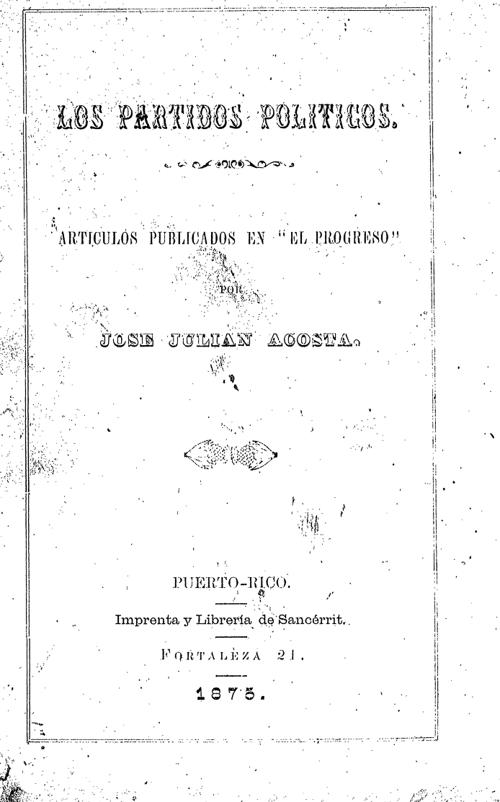
Los Partidos Políticos
Scans from the Library of Congress Hispanic Periodicals collection. 38 pages.
View full document →In 1875, José Julián Acosta collected his political writings from El Progreso and published them as a single volume under the title Los Partidos Políticos. The articles were originally written in September and October of 1870, in the immediate aftermath of the September Revolution in Spain and the December 1868 decree that gave Puerto Rico its first real opportunity at representation in the Spanish Córtes.
Acosta wrote them as a deliberate act of political education. Puerto Rico was about to send deputies to a constituent assembly for the first time. He believed the people were unprepared for the exercise of liberty not because they lacked the capacity for it, but because they had never been given the institutional conditions in which to practice it. These articles were his attempt to provide those conditions through the only instrument he fully trusted: the press.
The copy archived here was recovered from the Library of Congress in April 2026. It was printed at Fortaleza 21, San Juan, directly adjacent to the seat of colonial power. Acosta was not writing from the margins. That is the posture this publication inherits.
Four Principles Extracted from the Text
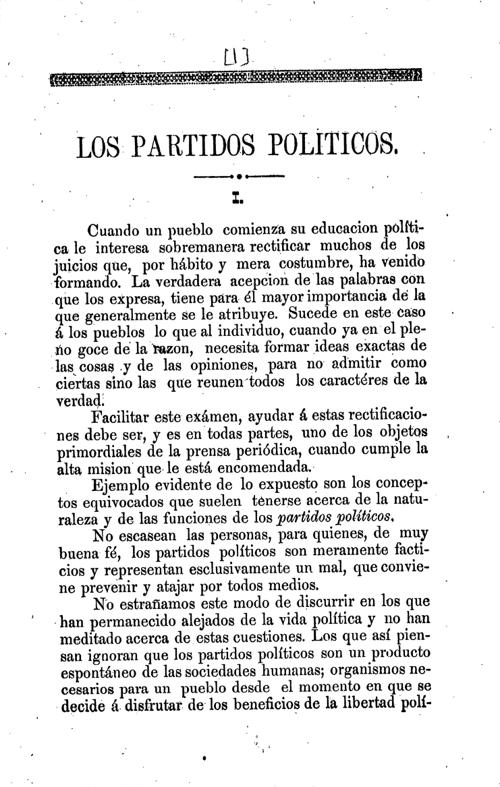
Para las sociedades no existen mas que dos caminos, dos sistemas: ó el régimen del silencio con todos sus dolores, ó el de la libre emisión del pensamiento con toda su virilidad. In servitute dolor, in libertate labor.
Society faces only two paths. The regime of silence — with its suffering, its compressed passion, its slow corruption. Or the free emission of thought, in all its vitality and risk. In servitude, pain. In liberty, labor.
Las banderías, con su esclusivismo é intransigencia, han sido constantemente funestas al progreso y á la libertad.
Factions — through their exclusivism and intransigence — have been constantly fatal to progress and to liberty. Acosta distinguishes between true parties, natural organisms of free societies, and "banderías": cliques driven by exclusion rather than principle.
El escritor que se vé siempre ante la opinión pública, cuyos fallos respeta, y que teme la contradiccion, si se siente refrenado y dado que no se extravíe, porque hablamos de los hombres tales como son y no de ángeles, nunca falta quien rectifique ó combata sus opiniones.
The writer who always stands before public opinion, who respects its judgment and fears contradiction — being restrained, not going astray, because we speak of men as they are, not as angels — there will never lack someone to correct or challenge their views. The press disciplines itself through exposure.
La eleccion de Diputados constituyentes es el acto político mas importante en la vida de un pueblo, por la razon de que en ella se verifica la delegacion de la Soberanía.
The election of constituent Deputies is the most important political act in the life of a people — because it is in that act that the delegation of Sovereignty takes place. Acosta wrote this as Puerto Rico prepared to send deputies to the Córtes for the first time.
Article by Article
I
On the Nature of Political Parties and the Two Paths of Society
Sept. 7, 1870Acosta's foundational argument: society faces only two systems. The regime of silence, which produces suffering, compressed passion, violence, and corruption. Or the free emission of thought, which allows grievances to surface, reforms to proceed peacefully, and revolutions to be avoided. He establishes the distinction between true political parties and "banderías": factions driven by exclusivism and intransigence that are fatal to progress. The Latin motto — In servitute dolor, in libertate labor — appears here for the first time.
II
Puerto Rico's Colonial History and the Origins of Political Division
Sept. 16, 1870Acosta traces Puerto Rico's political history from the earliest colonization of San Juan. He examines how the rivalries of Ponce de León and Diego Díaz, and the machinations of Admiral Diego Colón, divided and weakened the nascent colony. He argues that the gradual centralization of governance in the metropolis, at the expense of local institutions, is the original structural error whose consequences the island still bears.
III
Ramón Power and the Birth of Puerto Rico's Liberal Party
Sept. 18, 1870Acosta turns to the moment he considers Puerto Rico's first genuine political breakthrough: the election of Ramón Power as the island's representative to the Spanish Córtes in 1810. He describes how from this election emerged, spontaneously and without external direction, the first true liberal party in Puerto Rico. He holds Power's work as the model for what principled political engagement looks like.
IV
The Reformers of Cádiz: Aurora Fugaz
Sept. 18, 1870Acosta calls the liberal reformers of Cádiz a "fugaz aurora" — a fleeting dawn. The constitution of 1812 briefly opened Puerto Rico to freedoms it had never known. By 1814, the storm descended: Napoleon's fall, the return of absolutism, the restoration of the Inquisition. Acosta refuses cynicism. By 1866–67, reform movements resurged. The revolution of September 1868 changed everything.
V
The Elections of 1869 and the Failure of the First Diputación
Sept. 23, 1870Acosta's most devastating analysis. He examines Puerto Rico's first elections for the Constituent Córtes in June 1869 and diagnoses why they failed to produce effective representation. Two causes: the complete ignorance of the population about electoral practices, and the non-existence of true political parties. The conclusion: the delegation of sovereignty requires preparation, education, and institutional structure. Without them, representation is theater.
This document is held by the Library of Congress, Chronicling America / Hispanic Periodicals collection. Los Partidos Políticos: Artículos publicados en "El Progreso" por José Julián Acosta. Puerto Rico: Imprenta y Librería de Sancérrit, Fortaleza 21, 1875. 38 pages. Recovered and archived by El Progreso, April 2026.
View at Library of Congress